Backing tracks
Practise along with your own audio
Import from Files or iCloud Drive, or play from Apple Music. A mini player stays available while you play.
Everything in the rig
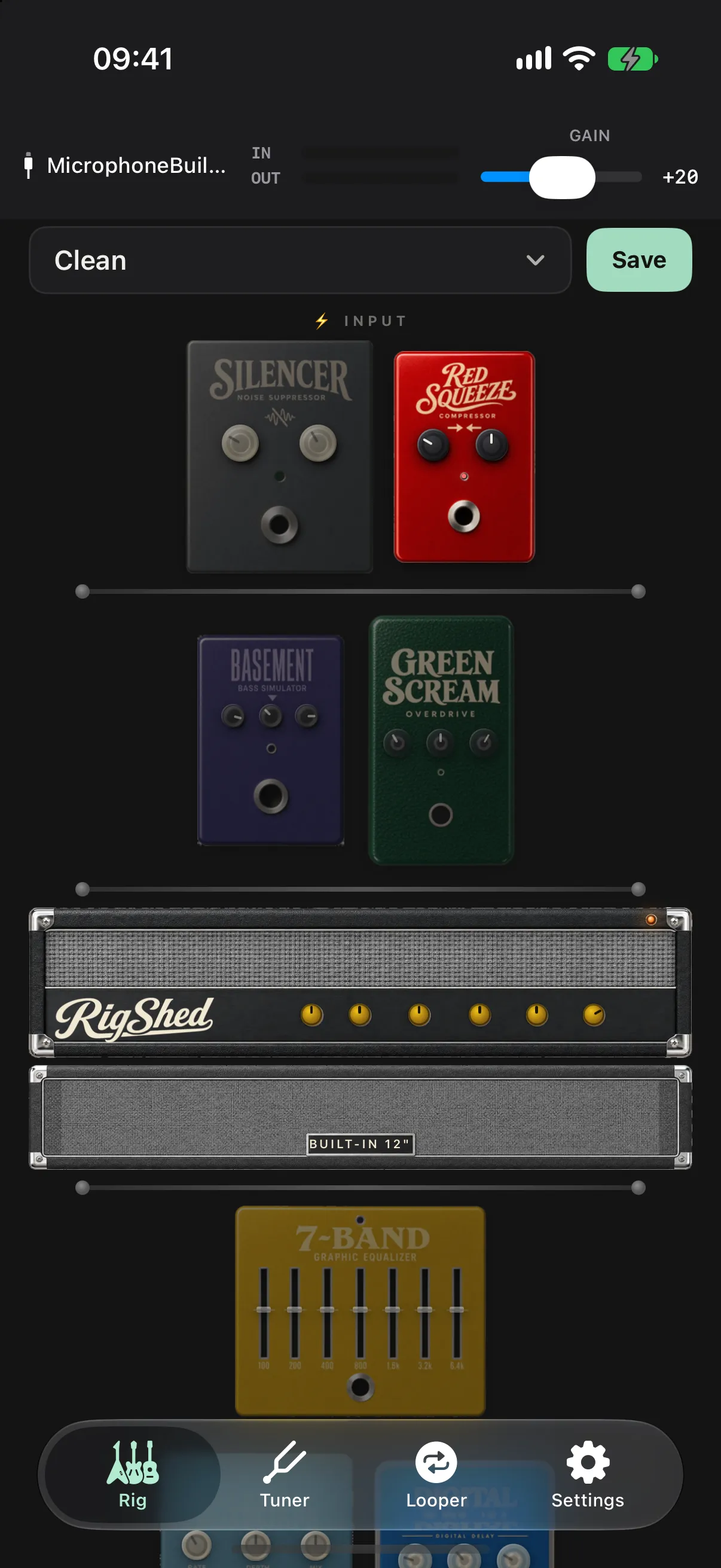
Plug a guitar in through an audio interface and RigShed becomes a pedalboard, an amp head, a speaker cabinet, a tuner, a looper and a backing-track player. The signal path is a real one, in an order you can change, and every control on screen drives actual DSP.
The signal path
Nothing here is arranged for convenience. The chain runs the way a board runs, which is why the controls behave the way you expect them to — and since the engine started walking a configurable order rather than a fixed sequence, you can move things and hear what happens.
The default order
The amp is an anchor rather than an effect: it is where the signal splits and the amp and cab run, so everything before it is in front of the amp and everything after it is after the amp. Every valid order contains the amp exactly once. A drive pushing an amp is a different sound from a drive chewing on the amp's output — measured at 74.5% of reference level between the two.
The tone stack sits before the valve stage and presence after it, which is where they sit on the real circuit. Turning the bass up genuinely drives the amp harder; presence stays clean.
38 pedals
Each pedal is a distinct DSP voicing rather than a preset on a shared effect, and each has its own enclosure. Five noise gates, five compressors, six drives, five equalisers, six modulations, five delays and five reverbs.
The amp
The built-in amp is our own analytic circuit model of a blackface-style valve combo into a 12-inch open-back cabinet. It is not a neural capture and not a sample. Its parameters were fitted numerically against a stepped-sine and third-octave reference, over roughly 2,600 optimisation passes.
Six controls, all driving real DSP: Gain, Bass, Mid, Treble, Presence and Master.
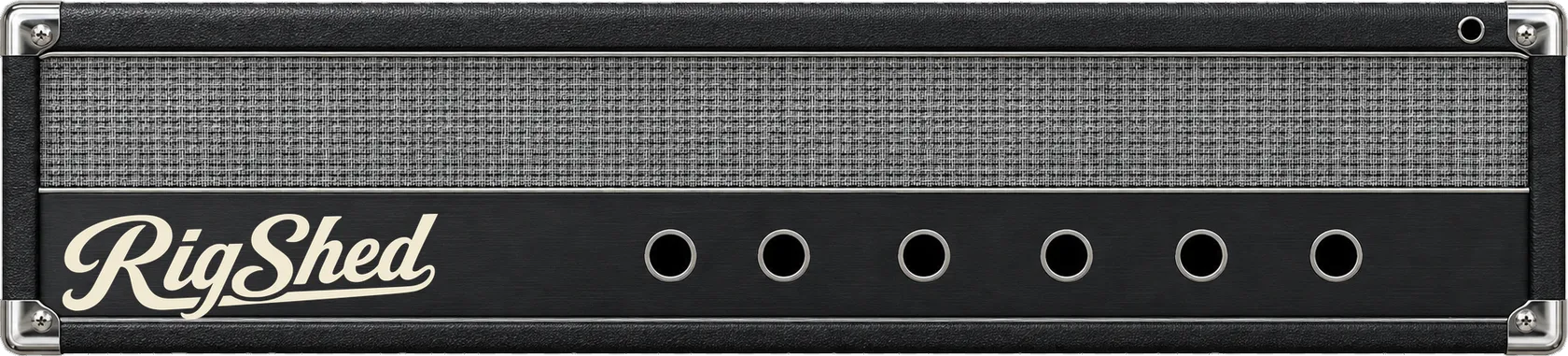
The second amp
Not the clean amp with the gain turned up — a different topology. Four cascaded gain stages into a sealed 4×12, where the clean amp drives a 12-inch open-back. A single distortion stage always trades saturation for mush; a cascade gets both.
Measured on a power chord, it produces 4.4 dB more upper-harmonic content than the clean amp driven by the hottest distortion pedal flat out, for 1.5 dB more intermodulation. Its response sits within 3.9 dB of a closed-back target from 60 Hz to 8 kHz, and it is level-matched to the clean amp, so switching compares tone rather than loudness.
It has seven knobs where the clean head has six. The extra one is Depth — power-amp feedback at the bottom end, the chest thump — and the clean amp has no equivalent.
On a major triad the two amps are about level. The gap is on power chords, which is what this music is played in.
The cabinet
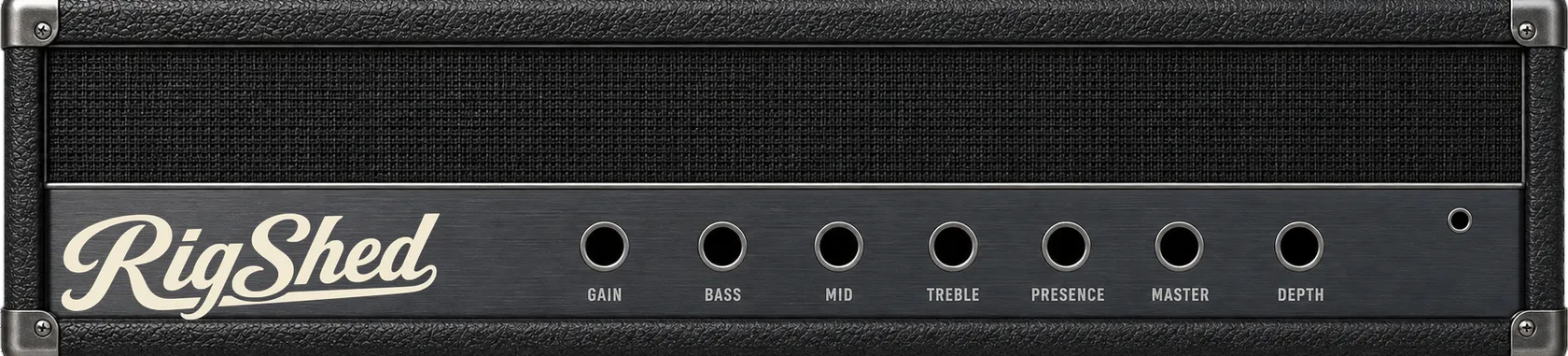
The cab sits under the head as a stack, because it is the speaker rather than something bolted on afterwards. Its badge names whichever speaker is in circuit — BUILT-IN 12" by default, or the name of a loaded impulse response.
You can load your own cab IRs. An IR replaces the amp's own speaker rather than stacking on top of it, so you get the cab you chose, not two cabs in series.

Tuner
Driven from the guitar input or the device microphone. It listens before the amp, so drive and reverb don't confuse it.
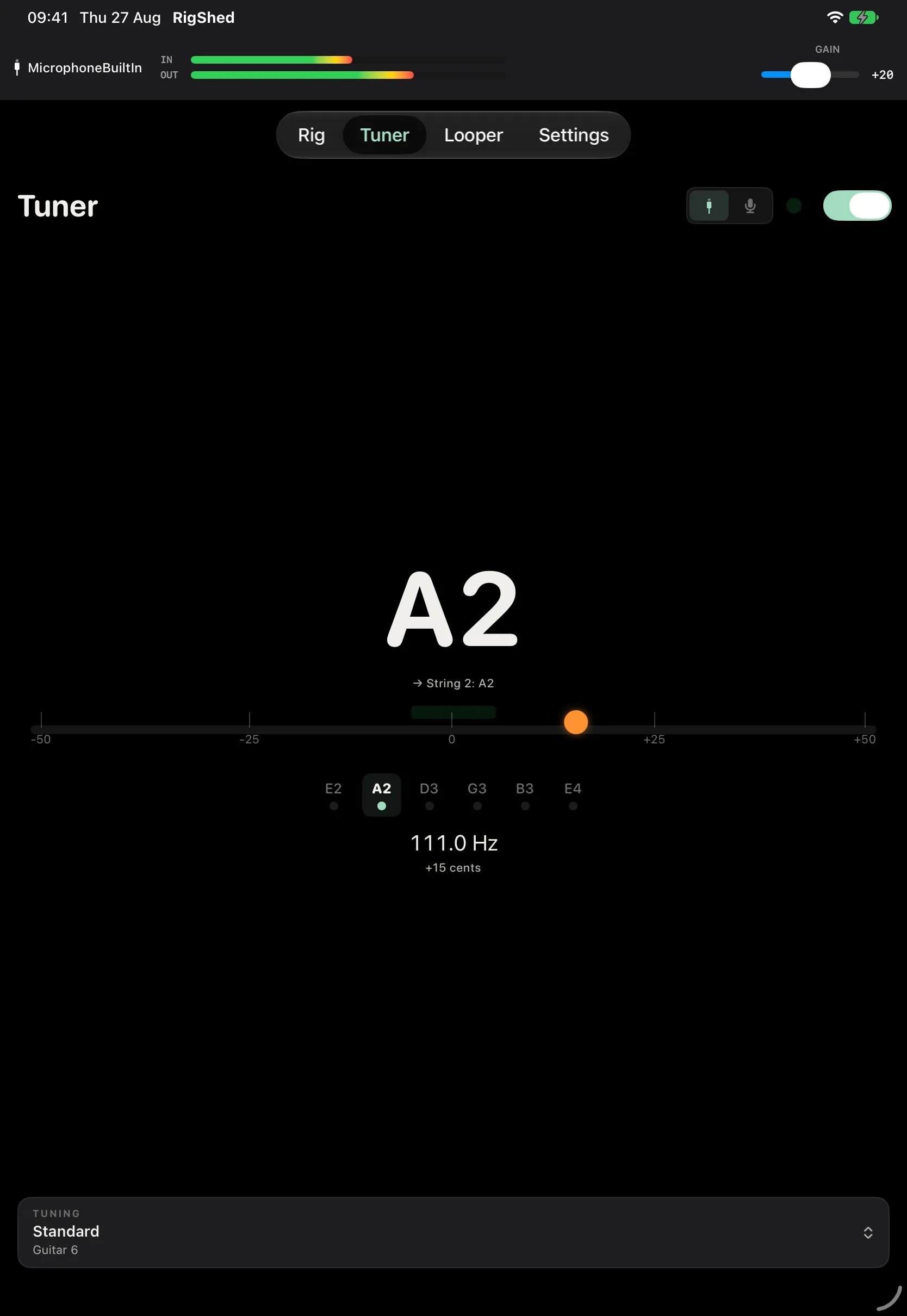
| Instrument | Tunings |
|---|---|
| Guitar, 6-string | Standard, Drop D, Drop C, Drop B, Half Step Down, Whole Step Down, DADGAD, Open D, Open G, Open E, Open C |
| Guitar, 7-string | Standard 7, Drop A |
| Bass, 4-string | Standard, Drop D, Half Step Down |
| Bass, 5-string | Standard 5, Drop A |
Looper
Up to 90 seconds, with every track holding its own rig. Record a rhythm part through a clean amp and play a lead over it through a drive, on separate tracks.
And the rest
Backing tracks
Import from Files or iCloud Drive, or play from Apple Music. A mini player stays available while you play.
Presets
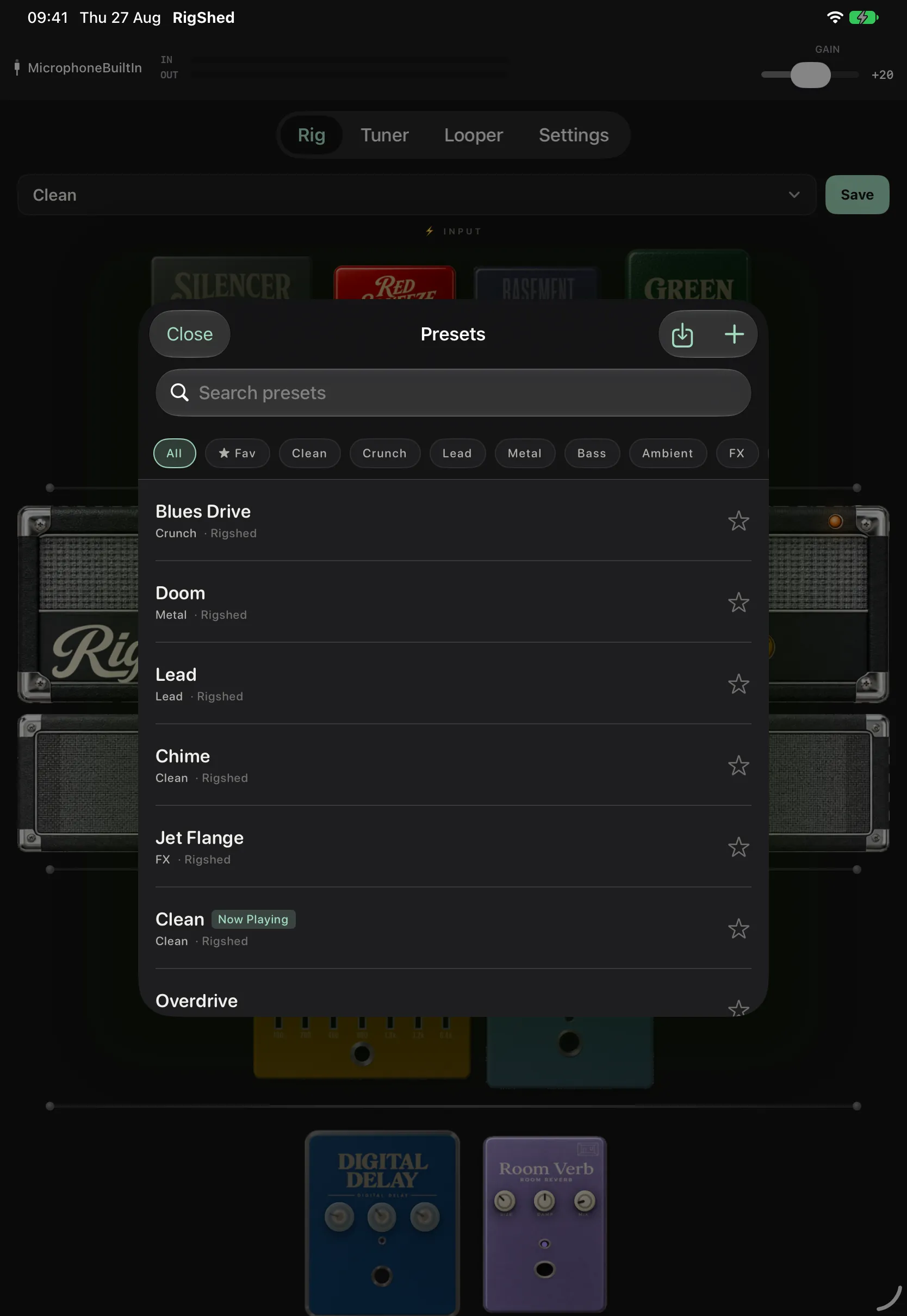
Fourteen factory presets ship with the app, across seven categories — clean, crunch, lead, metal, bass, ambient and FX. They are level-matched: every one lands at −18 dBFS RMS on the same played phrase, so switching between them compares tone rather than loudness. Before matching, the set spanned 12.1 dB. Your own saved rigs capture every parameter in the chain plus the loaded capture and cab IR, and export as .rigshed files to share.
MIDI
Map an external MIDI footswitch to bypass pedals, drive the looper and switch presets without touching the screen.
Hardware FX loop
A post-amp insert point, for running external hardware inside RigShed's signal path.
Where it runs
| Platform | Notes |
|---|---|
| iPhone | iOS 17 and later |
| iPad | Adaptive layout — a wider board and larger pedals, in landscape or portrait |
| Mac | A native app with its own three-pane desktop layout: presets and tuner left, board centre, looper and backing tracks right. Not a stretched iPad app. |
| AUv3 plug-in | Runs inside GarageBand, Logic, AUM, Cubasis and any AUv3 host |
Presets, captures and IRs are stored on your device and shared between the app and the plug-in, so both see the same library.
The whole tone engine is free, permanently. There is no trial to fall off.
Join the TestFlight beta — link pending