The amps
Two amps, because one could not do both jobs
Both of RigShed’s amps are our own analytic circuit models — the equations of a valve circuit, solved in real time. Neither is a neural capture and neither is a sample, which is why they cost almost nothing to run and why every knob still does what a knob on that circuit would do.
Measured, not claimed
The figures behind both
More saturation
4.4dB
Optimisation passes
2,600
Of one core
0.10%
The clean amp
Tuned by measurement, not by ear
A blackface-style valve combo of our own, into a 12-inch open-back cabinet. The interesting part is not what it is modelled on — it is how it was set. Its parameters were fitted numerically against a stepped-sine and third-octave reference over roughly 2,600 optimisation passes, rather than dialled in until somebody liked them.
It behaves like a valve amp rather than an EQ curve. The presence boost sits before the nonlinearity, so hard playing drives the top end into compression harder than it drives the mids — that level-dependent loss of brightness is most of what makes a valve amp feel alive under the hands. Push the gain and it gives +4.7 dB at 80 Hz but only +3.2 dB at 3 kHz.
The power amp sags. The rail droops under sustained load, so a hard-strummed chord compresses rather than simply getting louder. And the tone stack sits before the valve stage with presence after it, which is where they sit on the real circuit — so turning the bass up genuinely drives the amp harder instead of just adding bass.
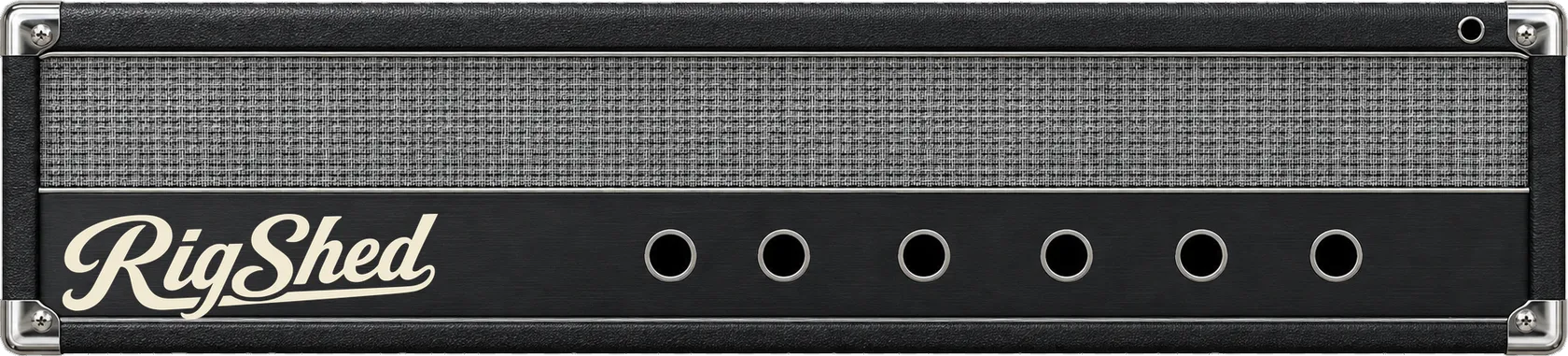
Controls: Gain · Bass · Mid · Treble · Presence · Master. All six drive real DSP.
The bass voicing
The amp has a second voicing, which the Basement octave pedal switches into automatically. This is not a flavour setting. The guitar voicing’s coupling stage costs 18.3 dB at 41 Hz — which is exactly the open E’s fundamental once an octave pedal has halved it — so a bass part through a guitar amp arrives with no bottom at all. The bass voicing moves the roll-off down to where a bass head puts it and swaps the 12-inch open-back for a large sealed driver. Measured, it returns 22.1 dB at 41 Hz and gives a response flat from 41 Hz to 1 kHz.
Foundry
The high-gain amp, and not the clean one turned up
A different topology. Four cascaded gain stages each saturating gently, rather than one stage clipping hard, driving a sealed 4×12 instead of the clean amp’s open-back 12.
The reason it exists is that a single clipping stage always trades saturation for mush, and measurement said so. On an E5 power chord — taking richness as upper harmonics against lower ones, and mush as inharmonic intermodulation against total output:
| Measured on a power chord | Richness | Mush |
|---|---|---|
| Clean amp, hottest drive pedal flat out | −19.4 dB | −16.5 dB |
| Foundry on its own | −15.0 dB | −15.0 dB |
4.4 dB more saturation for 1.5 dB more intermodulation — and the drive slot stays free, so a pedal in front is still available on top. That combination is what a single clipping stage cannot do however far you turn it up.
Its response is fitted to within 3.9 dB of a closed-back target across 60 Hz to 8 kHz, and it is level-matched to the clean amp, so switching between them compares tone rather than loudness. The saturation runs at 4× oversampling, so what you hear is harmonics of the note rather than fold-back — that costs 1.26% of a core against the clean amp’s 0.11%, which is the price of not sounding digital.
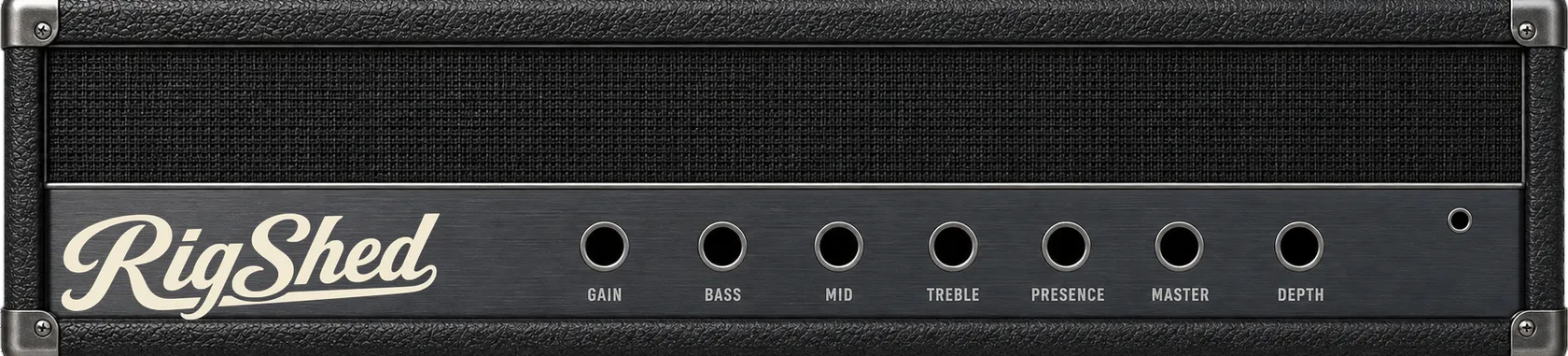
Controls: Gain · Bass · Mid · Treble · Presence · Master · Depth. Depth is power-amp feedback at the bottom end — the chest thump — and the clean amp has no equivalent. It is the visible reason the head has seven knobs rather than six.
The honest caveat: on a major triad the two amps are about level. The gap is on power chords, which is what this music is played in.
The cabinet
The speaker is part of the amp, not an effect after it
The cab sits under the head as a stack, because that is what it is.
Its badge names whichever speaker is in circuit — BUILT-IN
12" by default, or the name of whatever impulse response you
have loaded.
An IR replaces the amp’s own speaker rather than stacking on top of it. That is a deliberate choice and it is the one most often got wrong: run a cab sim into a cab sim and you get two cabs in series, which is a sound nobody wants and everybody blames on the IR.

Amp captures
Or bring an amp of your own
Neither amp locks you in. RigShed loads NAM (Neural Amp Modeler) captures — profiles of real amps, of which thousands are freely shared online — and your own cab impulse responses. Both are uncapped on the free tier: a limit on the captures you have made or downloaded would be a limit on the tone engine, and the tone engine is free.
When a capture is loaded the amp panel changes to that amp’s face, with Level and Mix controls and nothing else, because a capture is a fixed snapshot of one amp with its knobs in one position and has nothing else to offer. That is a property of the format, not of RigShed.
Both amps are free, and always will be
The whole tone engine is on the free tier — both amps, the cabinet, every pedal, and as many captures as you like.
Join the TestFlight beta — link pending